
By Tom Raftery | Host of Resilient Supply Chain | Updated November 2026
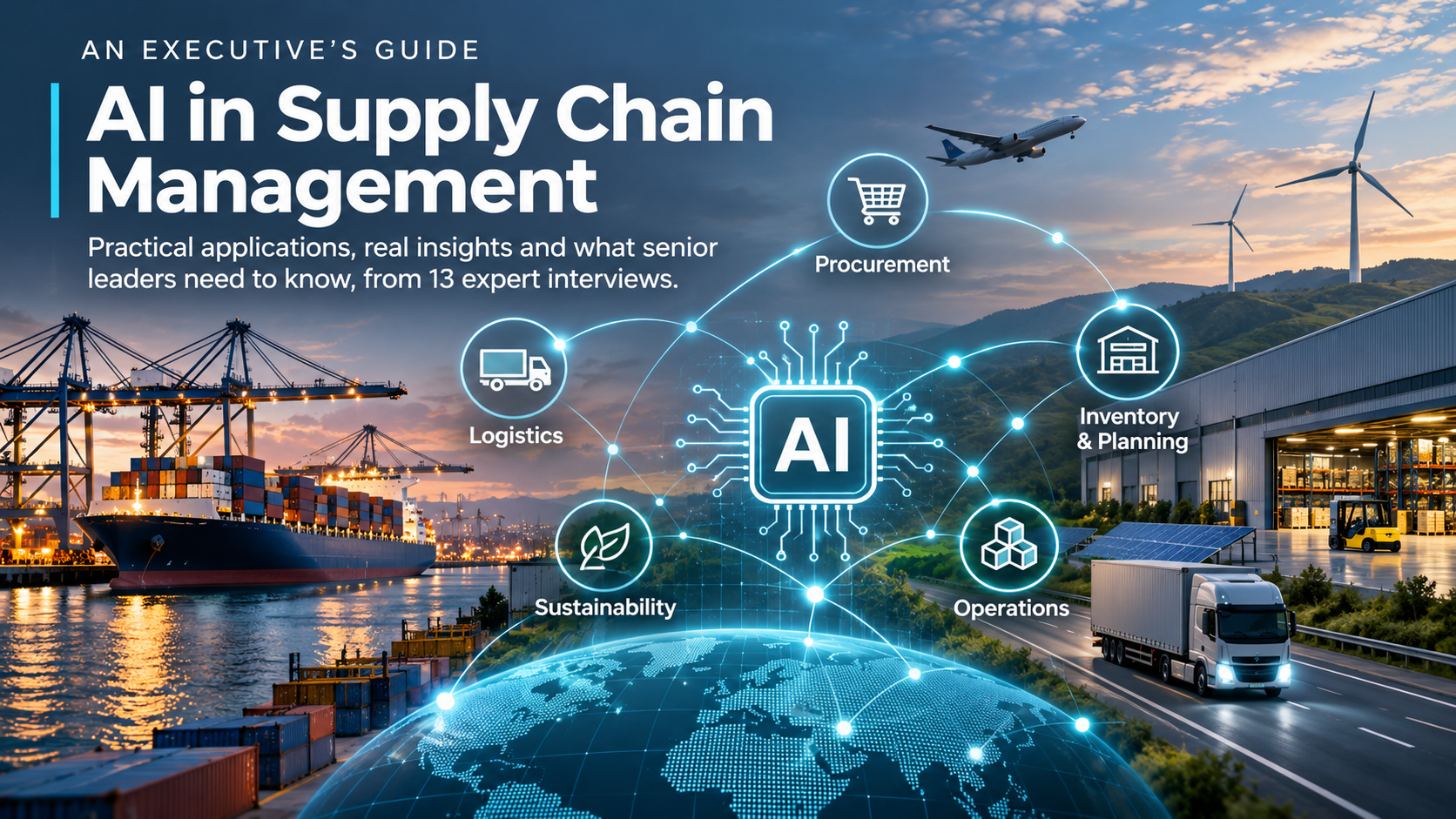
Artificial intelligence can help supply chain leaders forecast demand, allocate inventory, negotiate with suppliers, anticipate logistics disruptions and automate operational decisions. But value depends on more than model accuracy: the data must reflect what is happening, the decision must arrive in time to act, and someone must be accountable for the outcome.
Since 2019, I have interviewed executives, operators and technology specialists across more than 500 episodes of Resilient Supply Chain (previously Digital Supply Chain and Sustainable Supply Chain). This guide brings together a selection of those conversations, from early applications of machine learning to autonomous procurement and modern AI deployment. It is designed for leaders deciding where AI can deliver practical value, rather than for anyone looking for another list of tools.
The interviews below are organised by the decisions they address. Each link takes you to the original episode, where you can listen and consult the transcript. The examples and perspectives are attributed to the guests; they are not independent audits of their companies’ performance.
What is AI in supply chain management?
AI in supply chain management is the use of techniques such as machine learning, optimisation and language models to interpret operational data, predict outcomes, recommend actions or carry out decisions within defined constraints. Applications range from demand forecasting and inventory planning to supplier negotiations, transport scheduling, warehouse inventory checks and waste reduction. The important distinction is between generating information, supporting a decision and actually executing it. Each requires a different level of assurance.
1. Procurement: when should AI negotiate with suppliers?
Start with a category of decisions where acceptable terms can be defined, the supplier relationship can be protected and the consequences of an error are manageable. Autonomous negotiation is not the same as granting a model unlimited purchasing authority.
In my 2022 conversation with Pactum co-founder Martin Rand, he described software that can conduct negotiations, generate agreements and work within a value function agreed with the customer. His Maersk example illustrated an alternative to last-minute spot purchasing: negotiating short-term trucking contracts while containers are still at sea, giving carriers more time to plan capacity. In 2023, Arkestro’s Edmund Zagorin discussed a related but distinct challenge: evaluating a supplier’s overall offer, rather than simply optimising price, while making the process easier for the supplier.
- Martin Rand, Pactum (2022): Autonomous Supply Chains? — negotiated terms, boundaries and transport capacity.
- Edmund Zagorin, Arkestro (2023): Harnessing AI to Revolutionise Procurement — predictive sourcing, supplier experience and the value beyond price.
Executive question: Which negotiations could be delegated safely, and which require human judgement about strategic relationships, continuity of supply or exceptions?
2. Planning: how can AI balance inventory and service levels?
Treat uncertainty as an input to planning, not an inconvenience to hide behind a single forecast. Better predictions help, but the goal is to make better inventory and capacity decisions when predictions are wrong.
Jean-Baptiste Clouard of Flowlity explained how errors can accumulate as forecasts propagate through a multi-echelon network and discussed adjusting inventory buffers in response to demand and supply uncertainty. Bob Rogers of OII.AI took a complementary approach: using digital twins to explore what-if scenarios and identify where inventory is genuinely reducing risk. JF Gagné’s 2025 discussion added an organisational dimension: risk needs to be quantified, and cost-focused incentives can push buyers towards excess stock.
- Jean-Baptiste Clouard, Flowlity (2022): Using AI and ML for Inventory Planning — dynamic buffers and multi-echelon replenishment.
- Bob Rogers, OII.AI (2022): Black Holes, AI, and Supply Chain Digital Twins — scenario testing and the placement of inventory.
- JF Gagné (2025): Rethinking Supply Chain Planning: AI, Risk, and Sustainability — risk assessment and incentives that shape planning decisions.
Executive question: Are you measuring AI against forecast accuracy alone, or against service levels, working capital, stockouts and the cost of responding to uncertainty?
3. Data and integration: why do supply chain AI initiatives struggle to scale?
An AI system cannot compensate reliably for missing operational information, inconsistent definitions or disconnected execution systems. Before deploying a model, establish which decision it needs to support, what information is trustworthy enough for that decision and how the recommendation will be translated into action.
The archive provides a useful historical perspective. In June 2023, Scoutbee founder Gregor Stühler discussed grounding language models in business data rather than relying on general-purpose model knowledge alone. By 2026, the emphasis in several conversations had shifted towards the operational consequences of AI adoption. Sagar Paul argued that data quality should be assessed in relation to the decision it enables. Doron Hazan discussed sensing as part of a wider decision-making framework. JP Wiggins described how missing connectivity forces logistics teams back to email and phone calls, and argued for assessing AI against tangible use-case returns.
- Gregor Stühler, Scoutbee (2023): Revolutionising Supply Chains with AI and Large Language Models — an early perspective on enterprise data and language models.
- Sagar Paul, The Modern Data Company (2026): Supply Chain AI Can Scale the Data Problems Humans Used to Fix — data quality, decision context and risk.
- Doron Hazan, Wiliot (2026): Supply Chain AI Needs Better Sensing, Not Smarter Models — the physical-world information on which decisions depend.
- JP Wiggins, 1Logtech (2026): The Real Supply Chain Bottleneck Isn’t AI. It’s Integration — connectivity, practical implementation and return on investment.
Executive question: Can the proposed system access sufficiently reliable data, execute through the systems your teams actually use and show whether the resulting decision improved the outcome?
4. Logistics and warehousing: where does AI meet the physical world?
The strongest logistics use cases connect better information to an actionable operational decision. Predicting an arrival is useful if someone can adjust a transport plan; detecting an inventory discrepancy is useful if the warehouse can investigate and correct it.
In 2020, Portcast’s Nidhi Gupta explained the use of machine learning and data such as weather and vessel movement to predict shipping arrivals. In 2025, Jackie Wu of Corvus Robotics discussed autonomous drones that scan warehouse inventory, while Juan Meisel of Grip described combining carrier performance, weather and location data to improve perishable fulfilment decisions. These conversations illustrate different ways of connecting prediction or sensing with execution.
- Nidhi Gupta, Portcast (2020): Using Machine Learning to Increase Visibility and Forecasting in Global Shipping — arrival predictions and transport visibility.
- Jackie Wu, Corvus Robotics (2025): The Quiet Warehouse Problem AI Drones Can Finally Fix — physical inventory accuracy and autonomous scanning.
- Juan Meisel, Grip (2025): Cutting Waste in Cold Chain Logistics with AI — weather, carrier performance and perishable shipments.
Executive question: If an AI system identifies a late shipment, a misplaced pallet or a refrigeration risk, who is responsible for acting, and is there enough time to make a difference?
5. Sustainability: can AI reduce waste and environmental impacts?
AI can help identify avoidable inventory, spoilage and opportunities to reuse materials. But the environmental result depends on what changes physically, not just how many recommendations a system produces. Measure actual waste, material consumption, transport or energy use, and compare those outcomes with a credible baseline.
In my 2024 interview with Jon Goriup of VCG AI, we explored the idea of matching industrial byproducts with companies that could use them as resources. His discussion highlighted the importance of understanding the characteristics of the material, potential demand and local regulatory constraints. Finding a technically plausible match is a starting point, not proof of a viable or lower-emissions material flow.
- Jon Goriup, VCG AI (2024): AI-Driven Circularity: Turning Industrial Byproducts into Revenue Streams — identifying possible uses for byproducts and waste.
Executive question: How will you distinguish a model identifying a potential saving from a verified reduction in physical waste or greenhouse gas emissions?
Where should supply chain leaders start with AI?
My recommendation is to begin with a decision that already matters to your business, rather than a technology in search of a problem. The following checklist is my synthesis of the practical issues raised across these conversations.
- Define the decision: Identify the operational problem, decision owner and time available to act.
- Establish the baseline: Measure the existing cost, service, risk or environmental outcome before introducing AI.
- Check the inputs: Establish whether data are sufficiently timely, complete and reliable for the intended use.
- Set decision boundaries: Decide which actions can be automated, which require approval and how exceptions are escalated.
- Test execution: Verify whether recommendations can be acted on in existing workflows and systems.
- Measure the result: Compare actual operational outcomes with the baseline before scaling.
For a more detailed examination of the barriers between a technically successful pilot and a dependable operating capability, read my complimentary executive research brief: Why supply-chain AI pilots fail to deliver lasting value. The brief is available separately through a short request form; this listening guide is freely accessible.
Keep exploring Resilient Supply Chain
I publish a new episode of Resilient Supply Chain every Monday. If these conversations are useful, follow the podcast on Apple Podcasts, or search for Resilient Supply Chain in your preferred podcast app. You can also explore the full episode archive.
This guide is a curated starting point, not a systematic review of every AI-related interview. Guest roles and product discussions reflect the time of recording. I will update it as new conversations add evidence or challenge previous assumptions.