The missing market for time

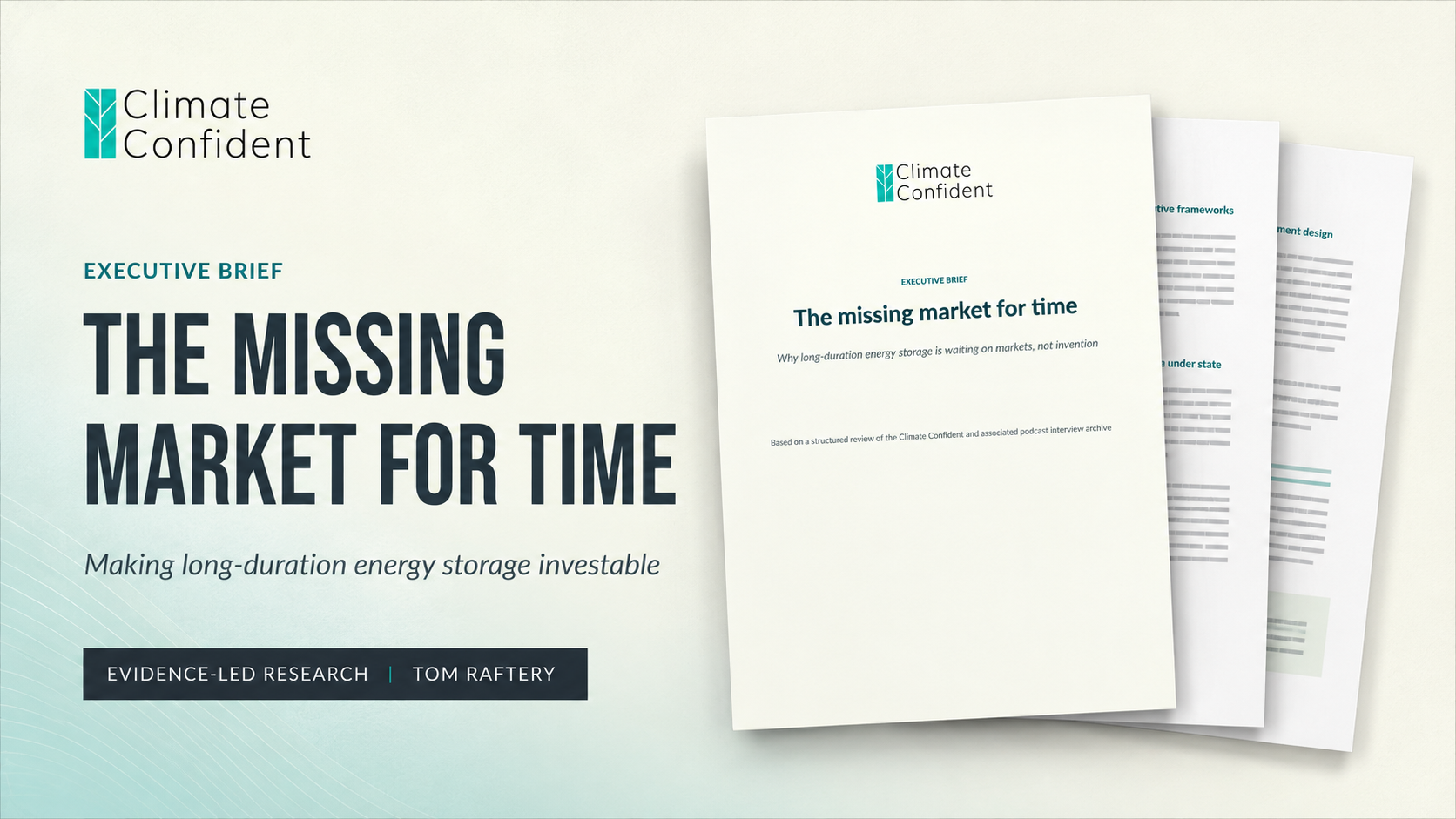
Missing Market for Time Exec Report cover

The missing market for time

What it will take to turn long-duration energy storage into dependable capacity

← Back to Research

Adding renewable generation is not the same as securing clean energy whenever it is needed. Solar output, wind conditions and demand do not always align. Closing those gaps requires more than additional megawatts: it requires the right combination of storage, networks, flexible demand and firm generation.

Long-duration energy storage can help. But technical capability alone does not create a financeable project—or one that can connect and operate on time.

The missing market for time examines what stands between storage potential and deployment: how systems define their needs, how markets reward availability, how contracts support investment, and how projects move from procurement into operation.

Download the free executive brief

PDF · 14 pages · No registration required

The central finding

Long-duration energy storage is not waiting for one decisive invention.

Across the interviews examined, a recurring obstacle is the difficulty of translating a system’s need for dependable energy into a service that can be specified, valued, contracted and delivered.

A project may offer useful capacity across many hours or days, yet struggle to earn sufficient revenue for that capability. A procurement programme may announce ambitious targets without providing contracts that lenders can underwrite. Even a financeable project can stall because of grid access, permitting or manufacturing constraints.

Technology still matters. Storage approaches differ in efficiency, maturity, siting requirements and reliability. The lesson is not that every technology is ready—or that storage is always the best answer. It is that technology readiness alone cannot explain, or resolve, the deployment challenge.

Four decisions that shape deployment

Define the gap before choosing the technology

Installed capacity does not tell planners whether a system can cover an evening peak, a prolonged wind lull or a seasonal shortfall.

Those are different requirements. Storage planning should begin with the periods that remain difficult to serve after networks, demand flexibility and other resources have been considered. Only then can buyers specify useful duration, response and reliability.

Pay for the service the system actually needs

An asset can create value without having a dependable way to capture it.

Markets may reward short-term balancing or electricity delivered now without adequately valuing availability across longer periods. Long-duration projects need access to payment structures that recognise the services they can verifiably provide—not simply an invitation to compete within products designed for something else.

Turn targets into financeable contracts

Targets signal ambition. Contracts determine whether capital follows.

Procurement needs to compare the cost of delivering the required service over an asset’s operating life, rather than focusing only on initial expenditure. Revenue certainty, performance obligations and a credible allocation of risk are central to making projects investable.

Treat delivery as part of the investment decision

A compelling business case does not secure a grid connection, a permit or a reliable supplier.

Manufacturing capacity, testing, warranties, service capability and operating responsibility must be assessed early. Leaving them until after procurement risks selecting a project that looks attractive on paper but cannot enter service when needed.

What the briefing helps leaders decide

The report provides a framework for asking:

  • Which periods of demand cannot be covered economically by existing flexibility?
  • What duration and reliability should procurement specify?
  • How will a project be paid for the services it delivers?
  • Which contractual arrangements can support investment while retaining performance accountability?
  • What could prevent the asset from being built, connected and operated on schedule?
  • Where would another resource—or a combination of resources—serve the system better?

It also examines the limits of the evidence, including technology-specific constraints and the distinction between industry accounts and independently verified operating performance.

Who this is for

This briefing is intended for utility and energy executives, storage developers, infrastructure investors, corporate energy buyers, and policy-makers responsible for electricity markets and procurement.

It is particularly relevant to leaders moving beyond storage targets towards decisions about projects, contracts and delivery.

About the research

The briefing draws on a structured review of 50 interviews selected from the Climate Confident, Resilient Supply Chain, Sustainable Supply Chain and Digital Supply Chain archives.

The selected interviews span January 2021 to September 2026. This range reflects the evidence retrieved, rather than a deliberately fixed study period. Fifteen interviews are cited in the final briefing.

The analysis distinguishes direct evidence about long-duration energy storage from broader storage evidence, contextual material and indirect analogies. It considers competing explanations and technology limitations alongside recurring deployment barriers.

The archive is an editorially selected collection of expert interviews, not a representative industry survey. The findings identify mechanisms and disagreements; they do not estimate how frequently each barrier occurs across the market. Contributor accounts should not be treated as independently audited project benchmarks.

Download the executive brief

Explore how system planning, market design, procurement and delivery determine whether long-duration energy storage becomes dependable operating capacity.

Download the free executive brief

PDF · 14 pages · No registration required

Explore more evidence-led executive briefings on the Research page.

Continue the conversation

I publish evidence-led analysis on energy, climate, supply-chain resilience and digital operations.

Join my newsletter

You can also explore the conversations behind this work through the Climate Confident podcast.